
Why unified communications become difficult to manage
Most communication platforms were never designed as one connected experience. Voice, Teams, mobile, collaboration tools, and legacy systems often evolve separately until communication becomes harder to manage consistently across the business.
As collaboration, hybrid working, and cloud communication continue to grow, internal IT teams are often left managing the operational gaps between platforms, suppliers, users, and sites.

Disconnected communication tools create friction across customer interactions and internal collaboration.
Voice, Teams, messaging, and mobile often operate separately across the organisation, creating support overhead and inconsistent experiences.
Ageing PBX systems and analogue services often remain in place long after the business has outgrown them.
As communication services expand, understanding how everything connects becomes increasingly difficult.
Your team becomes the glue between platforms, suppliers, users, and sites as communication grows more fragmented.
How connected are your communication platforms
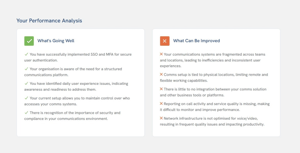
If communication feels harder to manage than it should be, the SmartComms Snapshot helps you understand where complexity, inconsistency, and hidden dependencies are creating drag for both IT teams and customer experience.
The SmartComms Snapshot shows how communication is performing across collaboration, customer interaction, resilience, and adoption.
What the SmartComms Snapshot assesses:
- Platform maturity and user adoption
- Security, governance, and compliance
- Customer communication experience
- Resilience and continuity readiness
- Integration and automation opportunities
What connected communication looks like
Customers increasingly expect faster, more seamless communication experiences. Unified communications deliver the greatest value when voice, collaboration, customer engagement, and connectivity work together as one integrated solution rather than separate systems your team must manage independently.
Communication feels more responsive, connected, and consistent across every interaction.
- Customers reach the right people faster
- Teams have better visibility across conversations
- Communication journeys feel more joined up
Voice, Teams, messaging, and collaboration tools work together more consistently across the organisation.
- Easier communication across teams and locations
- Fewer disconnected platforms to support
- Less day-to-day complexity for IT teams
You can clearly see how communication services, users, and workflows are performing.
- Better visibility across communication platforms
- Reduced hidden dependencies and legacy complexity
- Clearer insight into adoption and usage
AI-enabled communication and collaboration tools depend on connected, well-managed communication systems underneath them.
- Greater flexibility across hybrid teams and locations
- Easier adoption of AI-enabled communication tools
- Continuous improvement without major disruption
Visibility. Simplicity. Experience.
Most communication platforms become difficult for the same reasons: limited visibility, disconnected platforms, and inconsistent experiences for employees and customers.
You cannot improve communication effectively without understanding how services, users, and experiences are performing across the organisation. We help you improve visibility across platforms, collaboration tools, customer interaction, and legacy dependencies.
- Visibility across communication services and users
- Insight into platform adoption and usage
- Performance monitoring and reporting
- Clearer understanding of legacy dependencies
Communication should simplify how people work together, not create more support overhead for IT teams. We help reduce complexity by consolidating platforms, simplifying services, and improving day-to-day management.
- Simplified voice and collaboration systems
- Reduced supplier and platform sprawl
- Easier administration and onboarding
- More consistent communication management
Every interaction shapes how people experience your business. We help improve communication experiences across voice, Teams, collaboration, and customer interaction so communication feels more connected and consistent for both employees and customers.
- Better collaboration and accessibility
- Improved customer communication experiences
- More responsive communication across teams
- Modern cloud communication capabilities
Different ways to modernise communication
The right unified communication approach depends on your current setup, your customer communication requirements, and how your teams collaborate day to day.
Simplify voice, collaboration, and communication through a cloud platform designed to bring Teams, telephony, collaboration, and customer communication together more effectively.
This is the right next step if:
- Legacy phone systems are becoming difficult to support
- Communication platforms feel fragmented
- Your teams need greater flexibility across locations
- You want voice and collaboration to work together more consistently
Reliable communication depends on reliable connectivity underneath it.
Strengthen the connectivity supporting your communication platforms to improve resilience, call quality, and continuity.
This is the right next step if:
- Connectivity issues affect communication quality
- Legacy infrastructure still exists
- Business continuity needs improving
- You are preparing for cloud communication adoption
Many organisations still rely on ageing PBX systems and analogue services without fully understanding where dependencies still exist.
If you are concerned about the switch-off or rising legacy costs, we can help you understand what services may be affected and what your migration options look like.
This is the right next step if:
- Legacy PBX systems are becoming difficult to maintain
- PSTN or analogue services still support key processes
- The switch-off is creating uncertainty
- You need a clearer migration plan
Improve how your teams manage customer interaction across voice, digital channels, and AI-enabled customer engagement.
Customer experience platforms help bring communication, customer context, reporting, and automation together into one connected system - improving responsiveness, visibility, and consistency across every interaction.
This is the right next step if:
- Customer interactions are spread across disconnected systems or channels
- Teams lack visibility across conversations and customer history
- Resolution times and handoffs are becoming difficult to manage
- You want to improve customer experience without increasing operational complexity
Trusted communication and collaboration partners
We work with leading communication and cloud technology providers to deliver scalable, secure, and reliable unified communication services for UK businesses.


How unified communications improves over time
Communication should become easier to manage as your business evolves, not more fragmented. Babble helps you continuously improve unified communications through a structured approach focused on visibility, simplicity, and experience.
Modernise voice, Teams, collaboration, and cloud communication around how your people actually work and communicate.
Maintain visibility, support users, and improve communication performance without adding to your IT team’s workload.
Adapt communication capabilities as customer expectations, technologies, and business requirements continue to change.
This is how communication becomes easier to improve, easier to support, and more connected over time.
It's night and day between what we had and what we've got now.
What changed
Unified communication partnerships and accreditations

Meet the Unified Communication specialists
Communication platforms often evolve separately across locations, departments, collaboration tools, providers, and legacy systems. We help you simplify how communication works across your business so your communication systems become optimised for productivity, customer service, and ease of service management.
Talk to us about how to:
- modernise legacy voice and PBX systems
- simplify communication across Teams and cloud platforms
- improve customer and employee communication experiences
- reduce supplier and platform complexity
- create greater visibility across communication systems
FAQs
Yes. Many organisations still rely on PSTN and analogue services across critical systems and locations without fully understanding the operational impact or rising legacy costs.
Read more:
For many organisations, yes. Ageing infrastructure, hybrid working, customer expectations, and rising legacy costs are all accelerating cloud communication adoption.
Read more:
For many businesses, Teams Voice can successfully bring calling and collaboration together into one connected communication environment.
Read more:
Most communication platforms evolve separately across sites, suppliers, collaboration tools, mobile, and legacy systems. Over time, the gaps between them create increasing complexity for IT teams.
Read more:
Modern cloud communication platforms can deliver highly reliable communication when connectivity and resilience are designed properly.
Read more:
Usually, yes. Most organisations improve communication gradually by simplifying platforms, modernising legacy services, and improving visibility over time.
Read more: