
What happened
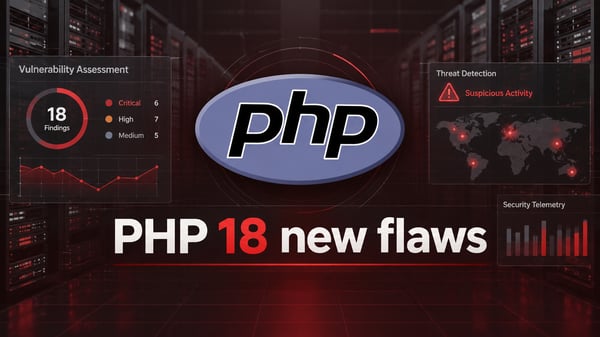
On 19 November 2026, PHP released fixes for 18 vulnerabilities, seven of them rated critical. The patched versions are PHP 8.5.13, 8.4.28, 8.3.37 and 8.2.36, and the new PHP 8.6.0 includes the fixes too.
The headline flaw, CVE-2026-129289 (severity 9.2), can let an unauthenticated attacker slip past the web server's routing controls and run code on the PHP process behind it. If your business runs PHP anywhere in websites, customer portals, internal tools, or vendor appliances, you’ll want to know whether you’re exposed.
It also lands just weeks after October's PHP2Shell emergency, which many teams believe they have already dealt with. That assumption is exactly what makes this release dangerous.
Why this is different from October
October's PHP2Shell was an emergency with proven damage: attackers were using it to break into unpatched security gateways and then gain root. November is a different kind of risk, and four things set it apart.
- October's fixes don't cover it. Teams that patched in October, or switched off upload-progress tracking, can still be exposed. The permanent fix for the October-disclosed session flaw (CVE-2026-115560) only arrived now, and two other bugs complete fixes that October left unfinished.
- Exposure depends on configuration, not just version. The headline flaw only bites where the web server keeps its connection to PHP-FPM open between requests — a setting often enabled to improve performance. Standard setups that close that connection fall outside the demonstrated attack.
- No confirmed attacks yet. As of 19 November, there was no public evidence of in-the-wild exploitation of the new flaw. That is a window to act, not a reason to wait.
- It reaches beyond code execution. One fix (CVE-2026-128064) stops PHP sending passwords, tokens and cookies unencrypted when an address is written in mixed case, such as "Https://". Another closes a path from a compromised worker to root on some Linux setups, including PHP's official container images.
What this means in plain terms
Think of a typical PHP website as a front desk and a back office. The web server is the front desk: it decides which requests are allowed in and where they go. PHP-FPM is the back office that does the actual work. To save time, some setups keep the door between them propped open instead of closing it after each visitor.
The headline flaw exploits that open door. An attacker can embed a second, hidden request inside the leftovers of a legitimate one. The back office treats it as a new job, even though the front desk never checked or approved it. The attacker then runs code with the same permissions as the website itself, and it's enough to read customer data, change content, plant malware, or move deeper into the network.
The other critical flaws work in quieter ways. Several target the session data that keeps users logged in, which could let an attacker tamper with accounts or run code through data the site trusts. Others corrupt memory, causing crashes at best and possible takeover at worst.
The unencrypted-traffic flaw deserves special attention because nothing visibly breaks. Passwords, tokens or customer records can travel in the clear with no error and no alert. If that data includes personal information, it could become a reportable incident under GDPR.
Finally, "seven critical versions" does not mean seven open doors on every server. Some flaws only affect PHP 8.5 and later; one does not affect PHP 8.2; several need specific settings or application code to be exploitable. The real question for any organisation is not "how bad is this?" but "which of these apply to how we run PHP?" and answering it fast depends on knowing our own setup.
What you should do now
1. Find every PHP instance. Include websites, internal apps, containers, and appliances or SaaS tools where a vendor runs PHP for us.2. Patch internet-facing systems first. Prioritise any that reuse backend connections between the web server and PHP-FPM, then upgrade everything else to the fixed branch release.
3. Use stopgaps only where patching must wait. Turn off backend connection reuse, restrict PHP-FPM and LSAPI listeners to trusted networks, and keep session.upload_progress.enabled=0 with workers restarted. Each covers one exposure; only the update covers all 18.
4. Check legacy and vendor builds. Older branches may have patched packages from third-party maintainers or vendors, but confirm coverage for the exact package or image you run.
5. Verify what is actually live. A command-line version check can mislead on hosts with several PHP installs. Confirm the version of the running worker or deployed image before closing the ticket.
6. Ask suppliers directly. Request written confirmation of their patch status and timeline for any product that runs PHP on our behalf.
What this should teach business leaders
"Patched" is a moment, not a state. A system that was safe in October can be exposed in November. Security status should be reported as an ongoing measure, not a box ticked once.
Fixes can be incomplete. Emergency patches buy time; follow-up releases often finish the job. Budget for a second round whenever a major vulnerability hits.
Performance choices carry security costs. A setting chosen to make systems faster created the exposure here. Configuration decisions deserve a security review, not just an engineering one.
You can't protect what you can't see. Many organisations don't know where PHP runs, or which version is live. An accurate inventory of software and suppliers is the foundation of every fast response.
Speed beats severity scores. Seven "critical" flaws are not equally dangerous to every business, but the gap between disclosure and attack keeps shrinking. Teams that can triage, patch and verify within days will outlast those waiting for proof of attacks.