
Most businesses hand cyber security to someone they trust. That might be an IT provider, a managed security service or an internal team.
The point is peace of mind: someone is watching, and they'll act if something looks wrong.
Then a customer, a supplier or your insurer asks a simple question: what are you doing to keep your business secure? It might come on an insurance renewal form, a supplier due-diligence questionnaire or a tender.
"We have a provider" tells them who looks after it. It doesn't tell them what's being done, or how you know it's working. And if you'd struggle to answer, that's rarely because the service is failing. Usually, the evidence exists, you just can't see it.
This article looks at four signs that you may not have a clear view of how your cyber security protection is working. For each one, it covers the evidence to ask for so you can show with confidence what you already have.
Four signs you may not have a clear view
1. You only hear from your provider when something goes wrong
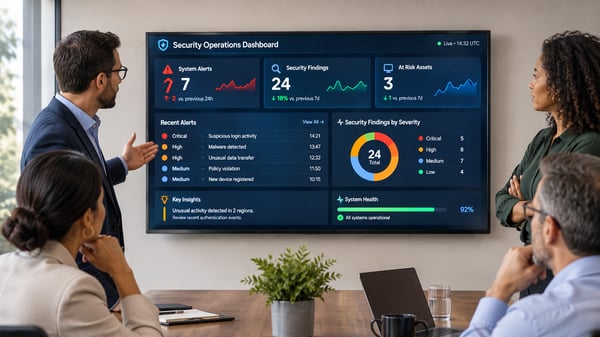
The most common frustration we hear at Babble is simple: "I couldn't tell you what we're actually getting." Threats may be found and handled, but if nobody shares that, you can't see it. That makes it hard to reassure your leadership team, let alone a customer.
Silence when things are quiet is normal. Having no record of what's been happening isn't.
Evidence to ask for: Regular reporting that shows the alerts received, the action taken and how each was resolved. Ask for scheduled reviews, monthly or quarterly, rather than only a call after an incident.
2. You're not sure what "response" means
"We'll respond within four hours" can mean different things. For some services, incident response means acknowledging an alert. For others, it means containing the threat. The gap between the two matters, because every minute between detection and action gives an attacker more time.
Evidence to ask for: The agreed response time for a critical alert, in writing, with a clear definition of what "response" includes. Ask how it's measured, and for recent figures that show it in practice.
3. Nobody's quite sure what happens at 2am
Many services describe themselves as round-the-clock. In practice, some have people actively watching and responding overnight. Others forward alerts by email outside office hours and wait for the morning. Neither approach is necessarily wrong, but your business should know which one it has.
Evidence to ask for: The hours that are actively covered, the escalation route for a serious alert, and which actions your provider can take without asking first. Also ask who in your business they would call, and how.
4. Alerts come from several places, and nobody owns the whole picture
Most businesses have several security tools, each with its own alerts and reports. When those aren't connected, one incident can show up three times, and it's hard to tell what matters. More tools can mean more noise, not more protection.
Evidence to ask for: Who reviews alerts across all your tools, and whether there's a single, prioritised view. If responsibility is split between your provider, another supplier and your own team, ask where that split is written down.
Two kinds of evidence
As you look at those four signs, it helps to separate two kinds of evidence.
What's been agreed. A service description or contract tells you what your provider has committed to: the hours, the response times and the actions they're authorized to take.
What has actually happened. Reports, review notes and test records tell you what took place: the alerts handled last month, or how long containment really took.
You need both. An agreement without records tells you the intention. Records without an agreement leave you unsure whether that's what you should expect. When someone asks how your business is protected, the strongest answer draws on both.
Three questions for your next cyber review
You don't need technical knowledge to start the conversation. These three questions work whether you use a managed service, an IT provider or an internal team:
- What were the most serious cyber-security alerts last quarter, and what happened with each?
- How quickly do we act on a critical alert, and how is that measured?
- If something serious happened at 2am on a Saturday, who would pick it up, what could they do, and who would they call?
A good provider will welcome these questions. Clear answers, backed by something you can see, are exactly what you'd want to share when a customer asks.
If the answer isn't clear
If you can't answer one of those questions straight away, that doesn't mean your protection isn't working. The evidence may simply sit with someone else, or a responsibility is shared and nobody has written down who does what. An unclear answer is a reason to ask, not proof of a gap.
Looking beyond monitoring
Alerts and response are one part of the picture. A customer or insurer may also ask who still has access to your systems, or how quickly you could recover after an attack.
At Babble, our cyber security specialists use a framework called HIDDEN to bring six connected areas into one view: human risk, identity management, data controls, disaster recovery, endpoint protection, and network and cloud security. The HIDDEN Gap Map puts one practical question for each area on a single page, with an example of the evidence that helps answer it.
Start with the question that matters most to your business and, take it into your next conversation with your provider or internal team.