


For many SMBs, cyber security still feels like something that happens to other people. Larger organisations, regulated enterprises, or companies with household-name brands. So when budgets tighten or priorities shift, incident response planning is often one of the first things to move down the priority list. Not because leaders don’t care, but because it doesn’t feel particularly urgent.
But it is. The problem is that cyber attacks aren’t reserved for the big players and don’t wait for the “right time” to strike. And when an incident does happen, the damage is rarely caused by the initial breach alone. It’s caused by confusion, delay, missed signals, and a lack of clear ownership in the hours that follow.
Having worked closely with SMBs for years, I’ve seen the same pattern repeat itself. This is not due to a lack of technology or even awareness, but a lack of preparation for what actually happens during a cyber incident: when pressure is high, information is incomplete, and decisions need to be made quickly.
In this article, we’ll be honest about why incident response planning still slips through the cracks for many SMBs, how today’s threat landscape makes that risky, and where things most often go wrong. It’s not the most cheerful read, but it does end with clear, practical steps you can take to get this right.
What This Article Covers:
- The Core Problem: “We’re Too Small to Be a Target”
- Why the 2026 Threat Landscape Makes This Worse
- What a Cyber Incident Looks Like Without a Plan
- Where Incident Response Commonly Breaks Down
- What Good Incident Response Planning Looks Like for SMBs
- Incident Response Is a Business Issue, Not Just an IT One
The Core Problem: “We’re Too Small to Be a Target”
 Over the last decade, one of the most persistent trends in cyber security has been the growing focus on SMBs. According to the UK government’s Cyber Security Breaches Survey 2025, 43% of UK businesses reported a cyber breach or attack in the last 12 months.
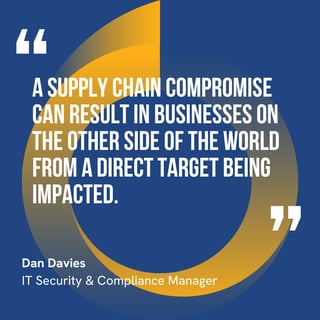
And while many business owners have begun to realise that there is a target on their back, the dangerous misconception still lingers: we’re too small to be worth attacking. There is some truth to that assumption, since SMBs aren’t always the primary targets. But attacks can spread quickly when they do happen. As Adam Bearder explains in this article, in many cases, cyber criminals use SMBs as a bridge to get to their much larger clients – an act known as “island hopping” or a “supply-chain attack”.
Modern attacks don’t need to be precise. They need to be scalable. And SMBs are often the path of least resistance.
Why the 2026 Threat Landscape Makes This Worse
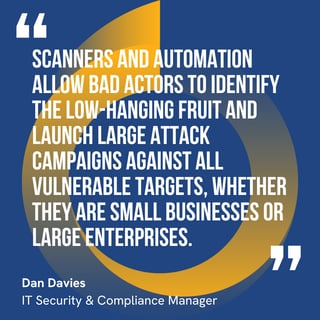
Unfortunately, the threat landscape has shifted in ways that disproportionately affect smaller organisations. Now we’re seeing state-sponsored groups and organised criminal operations operating at scale. Automation, scanning tools, and orchestration platforms allow attackers to identify vulnerable systems and launch widespread campaigns at a very low cost.
 This is compounded by the maturity of the cyber crime economy itself: ransomware-as-a-service models, off-the-shelf exploit kits, and criminal marketplaces mean that attackers no longer need deep technical expertise to cause serious damage.
As you might have guessed, generative AI has accelerated this trend even further. Not only by lowering the barrier to entry — making it easier to draft convincing phishing emails, modify malware, or test payloads — but now there are criminal AI tools, like Fraud GPT, being sold “as a service” to cyber criminals. The result isn’t that AI is autonomously hacking networks, but that attacks are easier to launch, harder to predict, and far more scalable than they were even a few years ago.
In short, the skill gap for cyber crime continues to shrink, while defensive IT teams are expected to do more with less.
What a Cyber Incident Looks Like Without a Plan
To understand why incident response planning matters, it helps to look at how a typical breach unfolds when there isn’t a plan in place.
A Business Email Compromise in Real Time
2:03 PM – Phishing Email Received
An employee (we’ll call him Sam) receives what appears to be an email from a trusted third-party vendor. It urges him to log in to a portal to resolve an outstanding issue. From a quick glance (mistake #1), the sender’s address looks legitimate.
2:34 PM – Malicious Link Clicked
Sam clicks the link and enters his credentials into a convincing replica of the vendor’s login page. Nothing happens – he isn’t logged into the portal, nor do any warning bells go off – so he assumes it’s a temporary issue and gets on with his day.
3:46 PM – First Suspicious Login Attempt
An IT administrator (Lucy) receives an alert showing a login attempt from an unusual location. It’s flagged, but not treated as urgent.
4:32 PM – Escalation Begins
More alerts appear. Lucy realises something isn’t right and notifies the security function.
4:59 PM – Breach Confirmed
Over two hours after the initial compromise, the organisation confirms that an active incident is underway. Internal teams are informed, but there’s no shared understanding of next steps.
8:12 PM – Loss of Control
The attacker has moved laterally: denial-of-service activity begins, systems become inaccessible, and monitoring tools lose visibility.
11:43 PM – Supply Chain Impact
Third-party vendors report suspicious emails originating from Sam’s compromised account. The incident has spread beyond the organisation.
The Next Morning
Employees, partners, and customers are discussing the incident publicly. Headlines follow shortly after.
None of this is unusual. But what is unusual is how often organisations assume they would spot and contain an attack far earlier (despite having no defined process to do so).
Why “We’ll Deal With It If It Happens” Isn’t a Strategy
Every cyber attack follows a lifecycle. And every stage of that lifecycle presents an opportunity to contain damage. In an ideal world, incidents are detected and neutralised within minutes. In reality, that only happens when responsibilities, authority, and actions are clearly defined before anything goes wrong.
Without a formal incident response plan, organisations rely on goodwill, best guesses, and informal escalation. That approach almost always breaks down under pressure. Preparation doesn’t prevent attacks. But it dramatically reduces the cost, duration, and impact when one inevitably occurs.
Where Incident Response Commonly Breaks Down
No Clear Documentation
Many organisations have security tools but no documented policy explaining how incidents should be handled, who is responsible, or what authority responders have.
Alert Fatigue
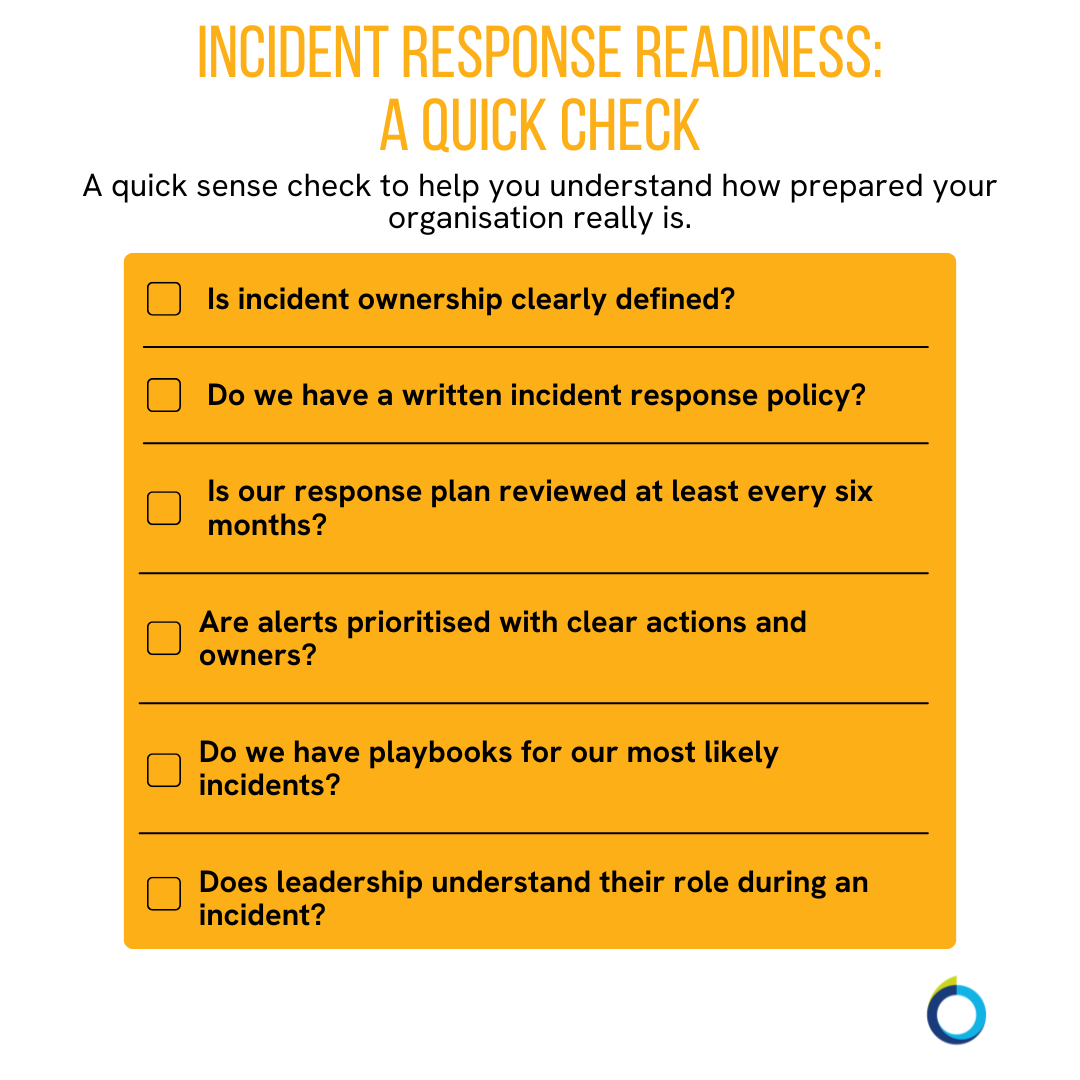
Modern environments generate vast volumes of alerts that the average small IT team frankly doesn’t have the bandwidth to handle. Without prioritisation, administrators (like Lucy) become desensitised, critical signals are missed, and response slows.
Practical steps include:
• Prioritising alerts by severity
• Eliminating redundant notifications
• Ensuring every alert has a clear, actionable next step
Over-Reliance on Tools (Including AI)
IBM’s Cost of a Data Breach Report 2025 finds that the organisations that extensively use AI can reduce breach lifecycle times and costs. This saves millions and shortens recovery times by dozens of days compared to those that don’t. But tools don’t replace planning. Automation supports responders; it doesn’t make decisions for them.
Organisational Silos
A recent Kaspersky report highlights a disconnect between IT teams, security specialists, and senior leadership. They found that 22% of IT leaders in the UK say their C-level peers do not fully grasp the business value of cyber security. Incident response fails when ownership is unclear and accountability is fragmented.
What Good Incident Response Planning Looks Like for SMBs
Effective incident response documentation falls into three categories that provide clarity:
-
Policies: High-level guidance covering terminology, scope, responsibilities, and enforcement.
-
Plans: Living documents outlining roles, communication paths, severity levels, and response lifecycles. These should be reviewed after incidents or at least every six months.
-
Playbooks: Detailed, scenario-specific guidance for incidents like ransomware, denial-of-service attacks, or business email compromise.
Frameworks Support Response — They Don’t Replace It
Frameworks like Lockheed Martin’s Cyber Kill Chain are useful because they provide structure. Most attacks progress through familiar stages:
Stage 1: Infiltration
• Reconnaissance
• Point of Entry (This is the earliest state at which the organisation can spot the attack.)
Stage 2: Exploration
• Escalation of Privileges
• Lateral Movement
Stage 3: Execution
• Command and Control
• Actions on Objectives
Understanding this progression enables your organisation to introduce controls that slow attackers down. Zero Trust principles, for example, limit lateral movement. But frameworks don’t stop attacks on their own. They only work when paired with clear response processes and empowered people.
Incident Response Is a Business Issue, Not Just an IT One
 Incident response is not a technical problem alone: it’s a business resilience issue. While you can’t predict every attack, the entire organisation needs to be ready when one happens.
Real change begins when leadership no longer sees cyber security as a cost centre, but an investment in continuity, credibility, and trust. Data security audits are done, processes are put in place, and governance is embedded throughout the organisation.
As an IT professional with extensive experience in the cyber security industry, what I’ve shared comes from working with real organisations and dealing with real incidents (not selling fear or silver bullets).
If you haven’t reviewed how your business would respond to a cyber incident in the last six months, now is the time. Start with ownership, documentation, and clarity. Everything else builds from there.


.png?width=40&height=40&name=CA%2021%2c%202026%2c%2009_42_21%20PM%20(1).png)