

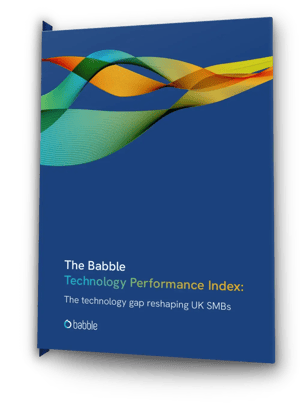
The Technology Performance Index brings together the research, findings, and analysis behind the technology confidence gap reshaping UK SMBs.
Drawing on independent research with 1,000 UK SMB leaders, it reveals why some organisations are pulling ahead through confident technology adoption, why others are finding it harder to keep pace, and the practical leadership insights that can help close the gap.
Inside the report you'll discover:
- Why UK SMBs are becoming a two-speed economy
- The behaviours separating Tech Vanguards from Tech Bystanders
- How AI and cyber resilience are reshaping competitiveness
- Why confidence is becoming a defining factor in business performance
- Practical leadership considerations for closing the gap
The technology confidence gap reshaping UK SMBs
Almost nine in ten SMB leaders agree technology is critical to business performance. Yet businesses are increasingly experiencing very different outcomes from technology investment.
Some organisations are successfully embedding technology, improving productivity and building competitive advantage. Others are spending more time fire-fighting, struggling to turn technology investment into measurable value and increasingly feeling at a disadvantage compared to competitors.
The Technology Performance Index found that the difference increasingly comes down to confidence: confidence in identifying opportunities, implementing change and turning technology investment into measurable business outcomes.
The three types of SMB
Based on responses from 1,000 UK SMB leaders, the Technology Performance Index identified three distinct groups of businesses.
These groups are not defined by sector, company size or technology spend. They are defined by confidence, capability and the ability to turn technology investment into business outcomes.
Tech Vanguard
25%
Businesses successfully embedding technology to improve productivity, growth and resilience.
They have the confidence, governance and repeatable processes needed to turn technology into measurable business value and are building a competitive advantage that becomes harder to close over time.
Emerging Adopter
41%
Businesses making progress but struggling to scale technology consistently across the organisation.
The ambition is there. The challenge is embedding technology effectively, maintaining momentum and turning individual successes into organisation-wide change.
Tech Bystander
34%
Businesses running hard under pressure and often making sensible decisions reactively or in isolation.
Technology is recognised as important, but competing priorities, limited capacity and a lack of confidence can make progress difficult, creating a growing risk of falling behind competitors moving faster.
The findings
SMB leaders know technology improves performance, but too many lack the confidence, board-level buy-in, skills and time to actually find the right technology for their business.
However, we are at a critical juncture. The businesses that fail to build technology confidence now risk becoming trapped in a cycle of inefficiency, missed opportunities and declining competitiveness. Many of these businesses are well positioned to adopt new technology, unencumbered from legacy infrastructure and siloed data.
Those that act now can create stronger foundations for innovation, accelerate growth, and play a vital role in powering the future UK economy.

Work slows down as teams switch between disconnected systems and fragmented processes
You can’t get a clear view of what’s happening in your environment – or where issues sit
Risk builds in the gaps between tools, ownership is unclear, and responses become reactive
Technology is underused, duplicated, or working against itself
This is the patchwork tax in action.
It’s not caused by the tools themselves - but by the way they’ve been added, managed, and left to operate in isolation, rather than as part of a single system.
And until recently, this was mainly an efficiency issue.
Are you a Tech Vanguard, Emerging Adopter or Tech Bystander?
The Technology Performance Index explains what's happening across the UK SMB market.
The Technology Performance Assessment shows where your organisation sits within it.
Using the same framework behind the national research, and taking just 4 minutes, the assessment benchmarks your organisation against 1,000 UK SMB leaders and helps you understand how effectively you're turning technology into business performance.
What you'll receive:
- Your Technology Performance category
- AI readiness insights
- Cyber resilience insights
- Customer experience maturity insights
- Personalised recommendations and next steps
Whether you're leading the pack, building momentum or trying to create a more structured approach to technology adoption, the assessment provides a practical benchmark for understanding where you are today and what to prioritise next.
- Why this is now a bigger problem
- What this is costing your business
- A better way to understand your environment
Why this is now a bigger problem
This used to be an efficiency problem.
Now it’s something more.
As businesses look to adopt AI and automation, the way your environment is structured matters more than ever. These technologies don’t fix fragmented environments - they depend on them.
When systems aren’t connected, AI can’t access the full picture. When data is inconsistent, outputs become unreliable. And when security isn’t structured, risk increases as information is exposed in new ways.
Instead of accelerating progress, AI often amplifies the gaps that already exist. And increasingly, that impact is felt at a business level, not just in IT.
What this is costing your business
Fragmentation no longer just creates inefficiency.
It limits your ability to grow, adapt, and compete - placing a ceiling on productivity, resilience, and innovation.
Because when your core systems operate in isolation, everything built on top of them becomes harder.
A better way to understand your environment
The issue isn’t a single tool - it’s how everything works together.
A Core Operating System is not something you buy, but something you already have. It’s the foundation your business depends on to operate, adapt, and grow.
When you see it this way, it becomes easier to understand what’s really going on - and where you can make improvements.
Work slows down as teams switch between disconnected systems and fragmented processes
You can’t get a clear view of what’s happening in your environment – or where issues sit
Risk builds in the gaps between tools, ownership is unclear, and responses become reactive
Technology is underused, duplicated, or working against itself
This is the patchwork tax in action.
It’s not caused by the tools themselves - but by the way they’ve been added, managed, and left to operate in isolation, rather than as part of a single system.
And until recently, this was mainly an efficiency issue.
About the Technology Performance Index
The Technology Performance Index is Babble's annual research programme exploring the relationship between technology confidence and business performance.
Built on independent research with UK SMB leaders, it exists to help business owners and leadership teams better understand the opportunities, risks and competitive realities shaping the future of their organisations.
The 2026 report is the beginning of that conversation.